
How to Use LinkedIn to Validate a Business Idea or Service Offering

Building a product or service in secret—and hoping people will buy it—is a risky strategy.
Many founders invest months of time and money, only to hear silence at launch. The problem is not always the idea. It is the lack of validation. In fast-moving, resource-constrained environments, testing early is essential. This guide shows how to use LinkedIn as a free, powerful validation tool—so you can refine your idea before you commit.
Run strategic LinkedIn polls
LinkedIn polls are one of the simplest ways to gather fast, structured feedback. But the key is asking the right question. Avoid asking, “Would you buy this?” People tend to say yes—but not act. Instead, focus on pain points: “What is your biggest challenge with [specific process]?”
Offer three clear options and include “Other (tell me in comments).” This gives you immediate insight into what your audience actually struggles with—turning assumptions into data.
Build in public to gauge organic interest
Do not wait until launch to talk about your idea. Share it while it is still evolving. Write a post describing a problem you have observed and your early thinking on how to solve it. Then ask:
> “Am I thinking about this the right way?”
> “How are you currently solving this?”
Pay attention to engagement. Comments, saves, and shares are signals of relevance.
In regions where digital platforms are helping women entrepreneurs expand beyond local networks, this kind of visibility can unlock both insight and opportunity.
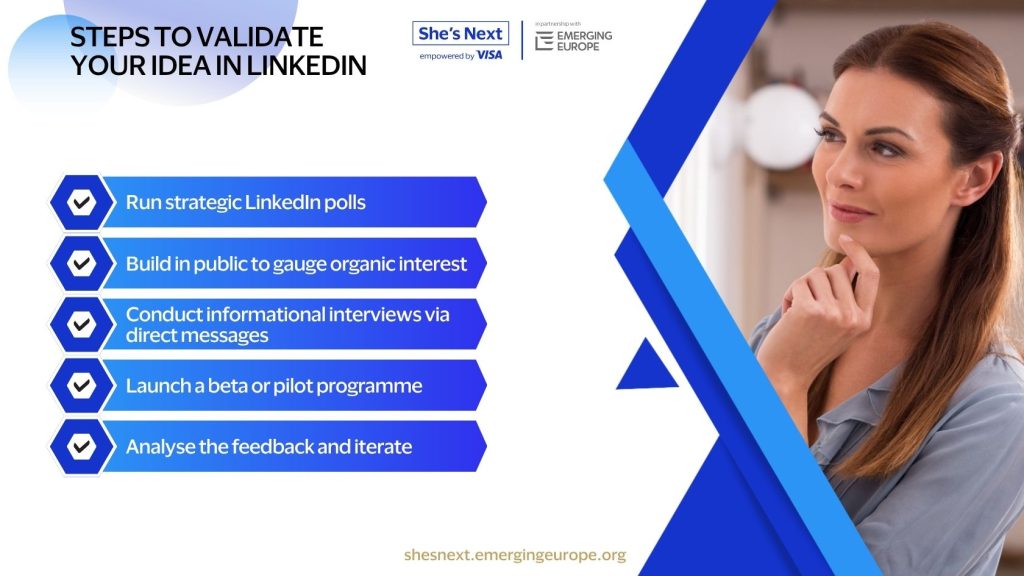

Conduct informational interviews via direct messages
Polls show patterns. Conversations reveal depth.
Reach out to 10–15 people who match your ideal client profile—especially those who engaged with your content. Keep your message clear and respectful: “I’m exploring a solution for [problem] and would value your perspective. Would you be open to a 15-minute chat?”
Make it explicit: you are not selling. You are learning. These conversations will uncover language, objections, and priorities you cannot get from data alone.
Launch a beta or pilot programme
Before going all in, test your idea in a controlled way.
Offer a limited version of your service to a small group—around five early adopters. You can offer it at a reduced price or in exchange for detailed feedback.
Share this openly on LinkedIn: “I’m inviting five founders to test a new solution for [problem]. In return, I’m asking for honest feedback.”
If you struggle to get even a few people to commit, that is valuable insight. It means something needs to change—your offer, your positioning, or your audience.
Analyse the feedback and iterate
Validation only works if you are willing to listen. Look at both the data and the conversations.
Which problem resonated most?
What objections came up repeatedly?
Did people hesitate at pricing or clarity?
Use this insight to refine your offer before scaling. Adjust your messaging, reposition your value, or even pivot the idea entirely. This iterative approach is critical in environments where many women entrepreneurs start small and grow step by step, often with limited resources.
Market validation is not a one-time task. It is an ongoing conversation with your audience.
Start this week: post one LinkedIn poll to test a key assumption about your customer’s biggest challenge.
New Free Courses — Made for Ambitious Women Entrepreneurs!
It’s time to grow smarter, adapt faster, and take your business global.
Explore two powerful courses available exclusively to She’s Next members:
The Reinvention Masterclass for Start-up Founders
Beyond Borders: Building for Global Success
Enroll today — it’s free!