
Creating a Multilingual Website to Attract Global Customers

When expanding internationally, your website is often your first handshake with new clients.
A multilingual site doesn’t just translate words — it builds connection, trust, and inclusion. By making your business accessible in multiple languages, you show customers that you value them. Here’s how to create a multilingual website that attracts and converts audiences across borders.
Identify target languages and markets
Start with strategy, not guesswork. Use analytics tools like Google Analytics or Semrush to see where your web traffic comes from and which markets show consistent interest. Focus on one or two key languages first — ideally where you already have inquiries or export potential. Consider cultural context, too: what content formats or tones resonate locally?
Tip: Let the data guide your priorities — your most engaged visitors can reveal your best next market.
Choose the right translation approach
Translation isn’t just linguistic — it’s emotional. Professional human translators ensure tone, nuance, and cultural accuracy. AI-powered tools such as Weglot or Lokalise can accelerate scaling but should be paired with human review for context and quality. Combining automation with editing gives you both efficiency and authenticity.
Tip: Avoid literal translation. Instead, use transcreation — adapting text so it sounds natural and engaging in the local language.
Localise content beyond language
True localisation goes deeper than words. Adapt currencies, measurements, visuals, and contact details to each market’s norms. Choose culturally appropriate images, colours, and examples. Optimise your SEO keywords for local search patterns — what people type in one country might differ slightly elsewhere.
Example: A “holiday sale” may resonate as a “summer special” or “end-of-year offer” elsewhere. Adapt meaning, not just vocabulary.
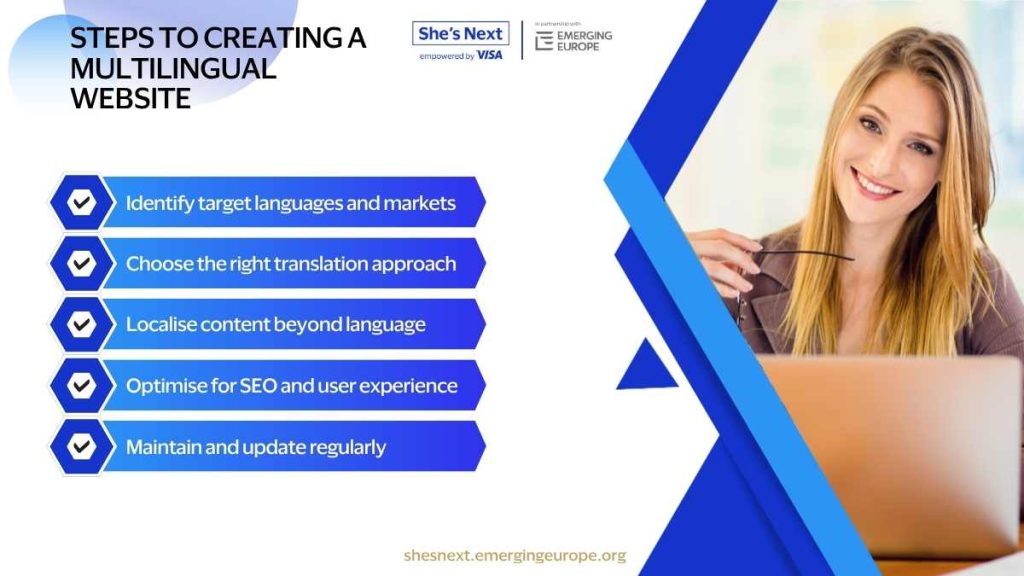
Optimise for SEO and user experience
Visibility and usability make or break your global reach. Add hreflang tags so Google serves the correct language to each visitor. Ensure your language switcher is visible and intuitive, and maintain fast page loading with compressed images and light design.
Tip: Test all translated pages on mobile devices — in many markets, most visitors browse and shop from their phones.
Maintain and update regularly
A multilingual website is a living project. Assign someone to update translated pages whenever your main content changes. Track analytics by language version — engagement rates, conversions, and bounce rates tell you where to improve. Ask for feedback from international visitors to refine tone, clarity, and visuals.
Tip: Treat each language version as part of your brand ecosystem, not a static copy. Consistency builds global trust.
A multilingual website is more than a translation — it’s a bridge to new opportunities. With the right mix of strategy, technology, and empathy, your digital presence can speak directly to customers’ hearts and habits. Start small, test, learn, and grow your global voice one language at a time.
New Free Courses — Made for Ambitious Women Entrepreneurs!
It’s time to grow smarter, adapt faster, and take your business global.
Explore two powerful courses available exclusively to She’s Next members:
The Reinvention Masterclass for Start-up Founders
Beyond Borders: Building for Global Success
Enroll today — it’s free!