
Mind your business

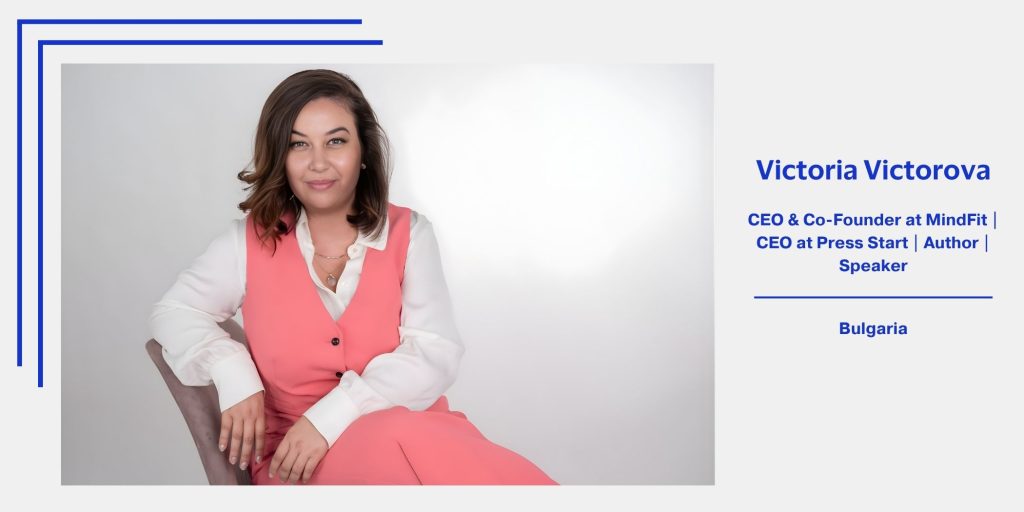
Victoria Victorova turned a decade of mental health struggles into Bulgaria’s leading corporate therapy platform.
The confession came during an ordinary workday at Press Start, Victoria Victorova’s Sofia-based gaming marketing agency. A teammate pulled her aside and told her that her anxiety had become unmanageable. Victorova knew the feeling. She’d spent ten years battling clinical depression herself.
“At the time I had some resources and availability to start working on this,” she recalls, “since I was shocked to find out that as an employer there’s not much I can do to support my teammates in these challenges.”
That moment sparked MindFit, a subscription platform, founded in 2021, that connects enterprise employees with vetted psychotherapists. Five years on, it’s Bulgaria’s leading provider of mental health services for corporate clients. The numbers tell their own story: stress and burnout cost Bulgarian companies over 200 million leva (roughly 100 million euros) annually during the Covid-19 pandemic.
“Getting the first clients was a matter of hard data,” Victorova explains. When she showed executives the numbers, most could name at least one employee exhibiting burnout symptoms—and calculate what that declining performance had cost.
The pitch has become easier since. Bulgarian firms increasingly grasp that mental health isn’t corporate charity but productivity optimisation. MindFit’s curated network of professionals offers employees confidential therapy at a fraction of typical costs, whilst employers benefit from reduced sick leave and improved performance.
Victorova’s efforts to normalise therapy—through speaking engagements, her book on impostor syndrome, and relentless advocacy—helped shift the conversation. Now companies seek her out.
Running multiple businesses while championing mental health sounds like a recipe for the very burnout she’s helping others prevent. Victorova founded Press Start a decade ago after gaming studios repeatedly tried to hire her—that rare mix of marketing specialist and genuine gamer. Rather than take a job, she built a team. The agency has since evolved beyond gaming.
Her approach: listen to her body. “There are times when I’ve planned to work during the weekend,” she says. “Yet, my body simply doesn’t obey my brain when it’s telling it to open the computer. It’s almost like a separate entity.” She’s learnt to recognise those moments as signals to rest. Social boundaries help too: notifications stay off when she’s with friends or family, and she resists the temptation to obsess over business ideas during actual conversations.
The irony isn’t lost on her. She wrote Impostor Syndrome: How to Step Out of Its Shadow whilst regularly experiencing the phenomenon herself. “I usually say I’m an impostor ‘in remission’,” she admits. Being hyper-aware of the psychological trap has armed her with tools—chiefly, reality checks. When numerous people praise something she’s done, she forces herself to consider whether they might have a point, even if she feels she’s performed poorly. She gathers hard evidence, sometimes anonymous feedback, and benchmarks progress against similar businesses. But it’s a delicate balance: “Impostor syndrome can get stronger when comparing ourselves to the wrong people.”

Some criticism is valid. Some achievements are real. The trick is sorting one from the other without swinging to extremes—neither dismissing all doubts as impostor syndrome nor ignoring genuine opportunities for improvement.
Victorova’s polymath background is impressive. Journalism taught her critical thinking; PR and marketing inform every venture; a bit of coding knowledge helps her “translate” between technical teams and clients. Psychology and neuroscience shape her understanding of user behaviour.
That multi-disciplinary view is an asset. Her journalism training proves particularly useful—knowing what would interest a journalist, she can direct attention to exactly those aspects of a brand that will attract visibility.
At the She’s Next Hackathon Grand Final, where Victorova was a speaker and expert, she was struck by how different the women entrepreneurs seemed, yet how united they were by purpose. What sets the programme apart, she reckons, is its commitment to being women-led. “In theory, She’s Next is a competition, yet so many partnerships form that it may be more of a talent hub. I love that.”
For women paralysed by the fear of not being “qualified enough” to start their venture, Victorova’s advice cuts straight to the point: “Define ‘enough’. What would make you ready? It can’t just be a feeling; it should be measurable or at least defined. A specific degree? A certain number of prospective clients? A particular sum saved? If you can identify concrete criteria, work towards them. If you can’t, just start—not by quitting your job tomorrow, but by taking steps. Run a survey, build a presentation, launch a social media channel. Just start and it will start flowing, allowing you to adjust the direction in real time.”
Her final thought carries the weight of someone who’s been on both sides of the self-doubt equation: “But most importantly: if you’re reading this, then you are good enough.”
MindFit now fields enquiries from companies without Victorova needing to pitch the hard data anymore. That shift—from having to convince firms that mental health matters to having them seek her out—marks how far Bulgarian corporate culture has travelled in five years. The maths proved persuasive: one employee on extended sick leave costs far more than a therapy subscription. But the real win came when executives stopped viewing mental health support as charity and started treating it as infrastructure, no different from IT support or legal counsel.
Victorova’s story won’t fit neatly into business school case studies. She built something valuable not by spotting a market gap but by refusing to ignore her own pain—and trusting that if she was struggling, others were too. MindFit exists because one employee found the courage to admit she wasn’t coping. That single moment of vulnerability, met with empathy, now helps many others. Scale, it turns out, starts small.
New Free Courses — Made for Ambitious Women Entrepreneurs!
It’s time to grow smarter, adapt faster, and take your business global.
Explore two powerful courses available exclusively to She’s Next members:
The Reinvention Masterclass for Start-up Founders
Beyond Borders: Building for Global Success
Enroll today — it’s free!