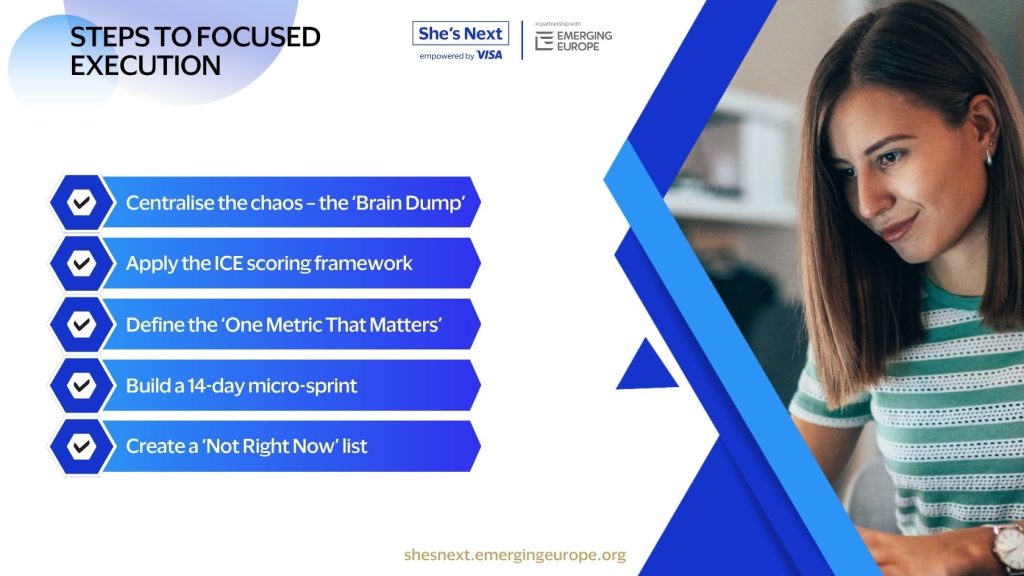


How to Move from Idea Overload to Focused Execution

Having too many ideas can be just as limiting as having none.
Founders who naturally see opportunities everywhere often fall into a pattern of constant starting and rarely finishing. This “idea overload” leads to scattered effort, slow progress, and, over time, burnout—for both the founder and the team.
The challenge is not creativity. It is focus. This guide outlines a practical framework to move from a crowded list of ideas to a clear, executable plan that drives results.
Centralise the chaos – the ‘Brain Dump’
You cannot prioritise what you have not externalised.
Start by capturing everything—ideas, features, campaigns, improvements—in one place. Do not filter or organise at this stage. The objective is simply to move thoughts out of your head and onto paper.
This reduces cognitive load immediately and creates a single source of truth for decision-making.
Apply the ICE scoring framework
Once your ideas are visible, remove emotion from the process.
Score your top ideas using three criteria:
> Impact – If successful, how much will this move your business forward?
> Confidence – How certain are you that this will work?
> Ease – How quickly and efficiently can this be executed?
Use a simple scale from 1 to 10 for each category.
You can also use AI to accelerate this step: “Act as a product manager. Score these five ideas using the ICE framework and recommend which one should be prioritised to generate results fastest.”
This introduces objectivity and prevents you from defaulting to the most exciting idea rather than the most effective one.