

How to Structure Learning and Upskilling While Running a Business

There is a clear paradox in entrepreneurship: as your business grows, your time to learn how to run it shrinks.

Many founders deprioritise their own development because they associate learning with long courses or dense books—formats that do not fit into a demanding schedule. As a result, they operate without upgrading the skills required for the next stage of growth.
The objective is not to learn more. It is to learn what matters, at the moment it matters. This guide outlines a structured, time-efficient approach to continuous upskilling.

Shift to ‘Just-in-Time’ learning

Most learning is done too early or too broadly. This creates knowledge that is rarely applied.
Instead, focus only on what directly supports your current priority. Identify the single most important challenge you are facing this month—whether it is improving sales, hiring, or launching a new product.
Then restrict your learning inputs—articles, podcasts, conversations—to that specific topic.
This ensures that everything you consume has immediate relevance and practical value.

Use AI for knowledge compression

You do not always need full-length content to extract useful insight.
Use AI tools to distil key ideas quickly: “Act as an executive business coach. Summarise the core frameworks from [book or topic] into five actionable points. Then explain how these can be applied in a small business context.”
This approach reduces hours of reading into minutes of focused insight. It also allows you to compare multiple perspectives quickly before deciding what to apply.
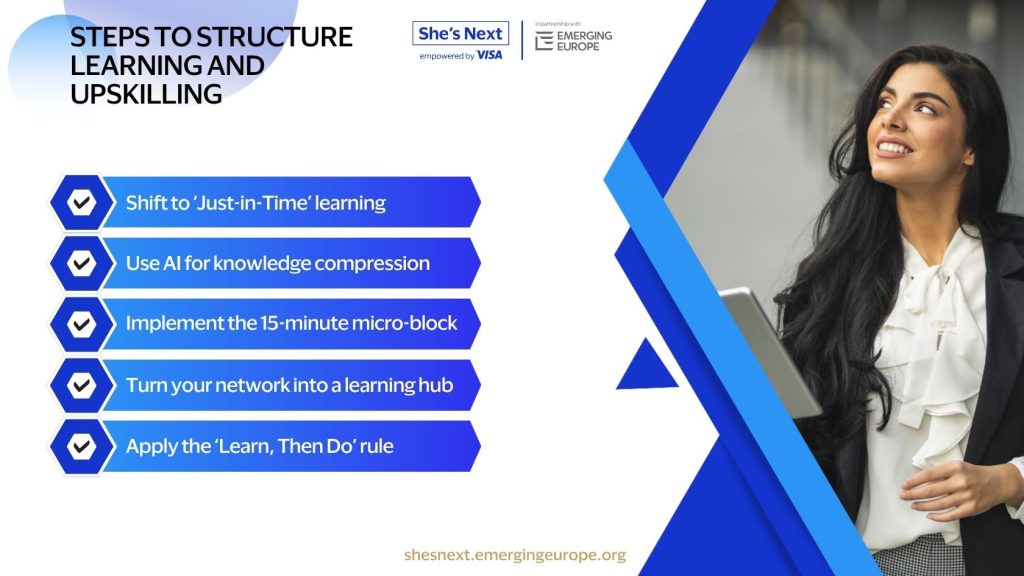

Implement the 15-minute micro-block

Consistency matters more than intensity. Set aside a fixed 15-minute block each day—preferably before checking email or starting operational work. Use this time to engage with targeted content or run structured AI prompts.
The constraint is deliberate. Short sessions are easier to sustain and reduce the risk of learning becoming a low-priority activity. Over time, these small inputs compound into meaningful capability.

Turn your network into a learning hub

Learning does not need to come from formal sources.
Your network is one of the most efficient ways to acquire practical knowledge—especially when dealing with real, current challenges.
Instead of broad conversations, structure interactions around specific problems. For example, arrange short, focused discussions with peers or other founders and ask how they approached a similar situation.
This provides context-rich insights that are immediately applicable.

Apply the ‘Learn, Then Do’ rule

Consumption without action creates the illusion of progress.
For every piece of content you engage with, define one concrete action you will take within the next 48 hours. This could be testing a new approach, adjusting a process, or implementing a small change.
If a source does not lead to actionable steps, reconsider its value. Execution is what converts knowledge into results.

Upskilling is not separate from running your business—it is part of it. The more effectively you learn, the more effectively you lead.
A practical next step: define your current priority, select one relevant learning source, and extract a single action you can implement within the next two days.

Related Articles