


How to Conduct Efficient Market Research Using AI Tools

Traditional market research has long been slow and expensive—often out of reach for early-stage businesses. At the same time, relying purely on instinct is rarely a reliable strategy, especially when entering new markets.

For entrepreneurs, AI tools now offer a more efficient alternative. Platforms like ChatGPT, Gemini, or Perplexity allow you to gather insights, analyse competitors, and understand customers in a fraction of the time.
This guide shows you how to turn AI into a practical market research tool—step by step.

Start with a hyper-specific research question

AI produces generic answers when given generic prompts. The quality of your output depends on the precision of your input.
Instead of asking: “What is happening in the e-commerce market?”, refine your question: “What are the fastest-growing e-commerce trends in the sustainable fashion sector in Uzbekistan and Kazakhstan in 2026?”
This level of specificity forces the AI to generate focused, relevant insights rather than broad summaries. A simple rule: always define industry, geography, and timeframe.

Perform instant competitor mapping

Understanding your competitive landscape is essential before entering any new market. AI can help you build a structured view within minutes.
Use a prompt such as: “Identify the top five competitors in [your region] offering [your service]. Create a table comparing their target audience, pricing models, and core marketing channels based on publicly available data.”
This gives you a clear overview of positioning, pricing, and go-to-market strategies.
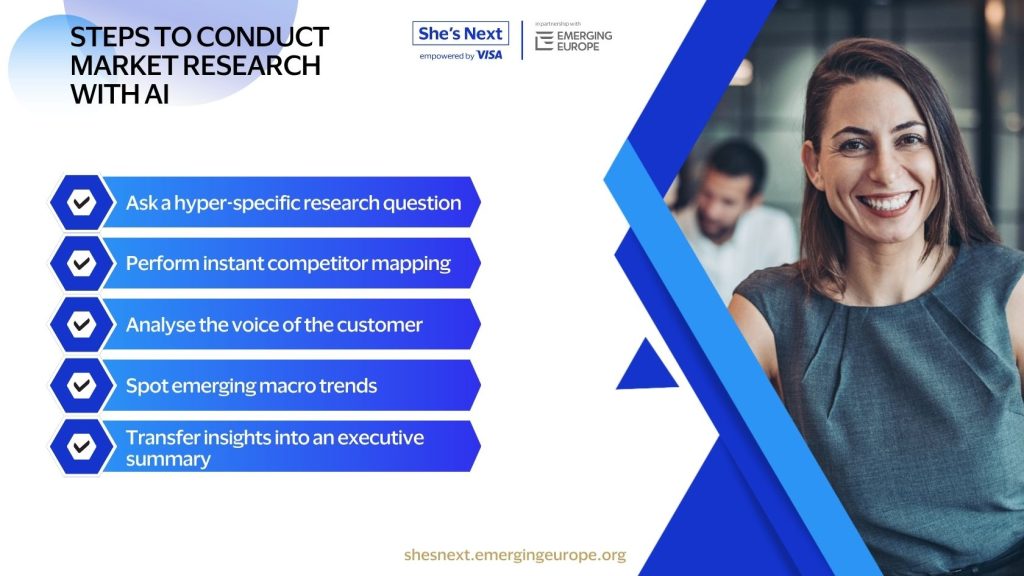

Analyse the voice of the customer

Customer reviews are one of the most valuable—and underused—sources of insight. AI allows you to process them at scale.
Take 50 to 100 reviews from platforms such as Trustpilot, Google Reviews, or app stores, and input them into your AI tool. Then prompt: “Analyse these reviews. Identify the three most common complaints and the three most valued features. What is the biggest unmet need?”
This reveals patterns that are difficult to spot manually.

Spot emerging macro trends

Competitor analysis shows where the market is today. Trend analysis shows where it is going.
Use AI to step back and take a broader view: “Act as a senior market analyst. Summarise the top three technological or consumer behaviour shifts that will impact the [your industry] sector in [your region] over the next three years.”
This helps you anticipate changes rather than react to them.

Synthesise insights into an executive summary

Data alone does not create value. Insight applied to decision-making does.
Ask the AI to consolidate your findings: “Based on the competitor analysis and customer insights, write a one-page executive summary outlining three specific market opportunities my business should pursue now.”
This step transforms fragmented information into clear strategic direction.

AI does not replace direct customer interaction—but it significantly accelerates the path to meaningful insight. It helps you identify where to focus before committing time and resources.
A practical next step: spend 15 minutes today analysing customer reviews of your main competitor. The patterns you uncover will likely reshape how you approach your market.

Related Articles