

Mind your business

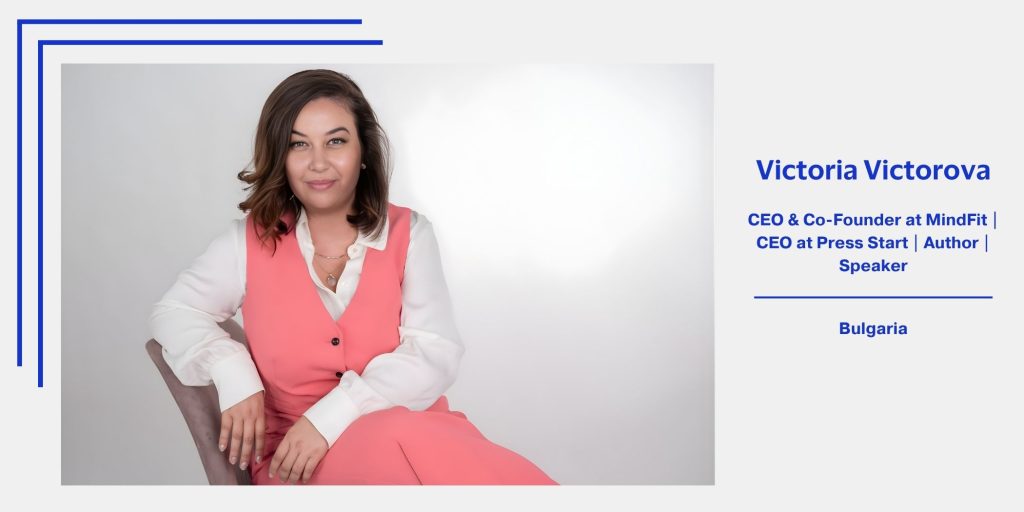
Victoria Victorova turned a decade of mental health struggles into Bulgaria’s leading corporate therapy platform.
The confession came during an ordinary workday at Press Start, Victoria Victorova’s Sofia-based gaming marketing agency. A teammate pulled her aside and told her that her anxiety had become unmanageable. Victorova knew the feeling. She’d spent ten years battling clinical depression herself.
“At the time I had some resources and availability to start working on this,” she recalls, “since I was shocked to find out that as an employer there’s not much I can do to support my teammates in these challenges.”
That moment sparked MindFit, a subscription platform, founded in 2021, that connects enterprise employees with vetted psychotherapists. Five years on, it’s Bulgaria’s leading provider of mental health services for corporate clients. The numbers tell their own story: stress and burnout cost Bulgarian companies over 200 million leva (roughly 100 million euros) annually during the Covid-19 pandemic.
“Getting the first clients was a matter of hard data,” Victorova explains. When she showed executives the numbers, most could name at least one employee exhibiting burnout symptoms—and calculate what that declining performance had cost.
The pitch has become easier since. Bulgarian firms increasingly grasp that mental health isn’t corporate charity but productivity optimisation. MindFit’s curated network of professionals offers employees confidential therapy at a fraction of typical costs, whilst employers benefit from reduced sick leave and improved performance.
Victorova’s efforts to normalise therapy—through speaking engagements, her book on impostor syndrome, and relentless advocacy—helped shift the conversation. Now companies seek her out.
Running multiple businesses while championing mental health sounds like a recipe for the very burnout she’s helping others prevent. Victorova founded Press Start a decade ago after gaming studios repeatedly tried to hire her—that rare mix of marketing specialist and genuine gamer. Rather than take a job, she built a team. The agency has since evolved beyond gaming.
Her approach: listen to her body. “There are times when I’ve planned to work during the weekend,” she says. “Yet, my body simply doesn’t obey my brain when it’s telling it to open the computer. It’s almost like a separate entity.” She’s learnt to recognise those moments as signals to rest. Social boundaries help too: notifications stay off when she’s with friends or family, and she resists the temptation to obsess over business ideas during actual conversations.
The irony isn’t lost on her. She wrote Impostor Syndrome: How to Step Out of Its Shadow whilst regularly experiencing the phenomenon herself. “I usually say I’m an impostor ‘in remission’,” she admits. Being hyper-aware of the psychological trap has armed her with tools—chiefly, reality checks. When numerous people praise something she’s done, she forces herself to consider whether they might have a point, even if she feels she’s performed poorly. She gathers hard evidence, sometimes anonymous feedback, and benchmarks progress against similar businesses. But it’s a delicate balance: “Impostor syndrome can get stronger when comparing ourselves to the wrong people.”