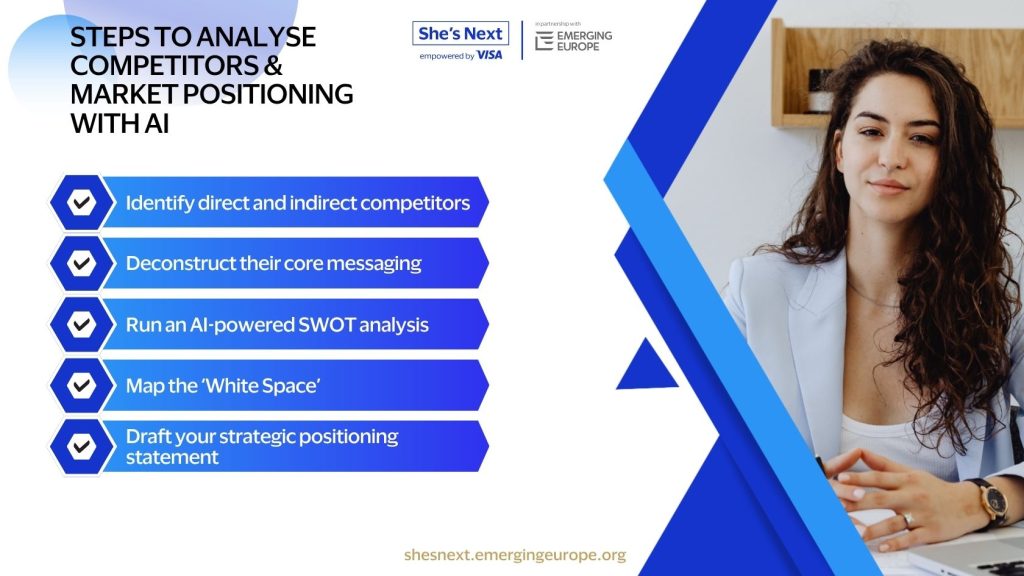


How to Analyse Competitors and Market Positioning with AI

You cannot stand out if you do not know who you are standing next to.
For many businesses, competitor analysis has traditionally been slow, manual, and expensive—often requiring agencies or weeks of research. As a result, many founders operate on assumptions rather than insight.
AI changes this. It allows you to map your competitive landscape, understand how others position themselves, and identify clear gaps in minutes. This guide shows you how to use AI to move from guesswork to precision.
Identify direct and indirect competitors
Most founders can name a few obvious competitors. What they often miss are indirect players solving the same problem differently.
Start by asking your AI tool: “I am launching a [your product/service] in [your market]. Identify three direct competitors offering the same solution, and three indirect competitors solving the same problem in a different way. Summarise their target audiences.”
This step broadens your perspective. It reveals not just who you compete with—but how customers might choose alternatives you had not considered.
Deconstruct their core messaging
Once you know your competitors, the next step is understanding how they position themselves.
Take the homepage or “About” page text from your top competitors and paste it into your AI tool. Then prompt: “Analyse this website copy. What emotional triggers, keywords, and promises are being used? What tone of voice do these brands adopt?”
This will show you patterns—whether competitors focus on trust, speed, price, innovation, or simplicity. The goal is not to copy. It is to see where messaging is repetitive, predictable, or overcrowded.
Run an AI-powered SWOT analysis
With a clearer view of the landscape, step back and analyse the market as a whole.
Use a prompt such as: “Act as a business strategist. Based on these competitors, generate a SWOT analysis for the [your industry] market. Highlight where competitors are weak or vulnerable.”
This gives you a structured view of:
> Where the market is strong
> Where it is saturated
> Where opportunities are emerging
> Where risks lie
Most importantly, it surfaces weaknesses that are not immediately visible when looking at competitors individually.