

Creating a Multilingual Website to Attract Global Customers

When expanding internationally, your website is often your first handshake with new clients.
A multilingual site doesn’t just translate words — it builds connection, trust, and inclusion. By making your business accessible in multiple languages, you show customers that you value them. Here’s how to create a multilingual website that attracts and converts audiences across borders.
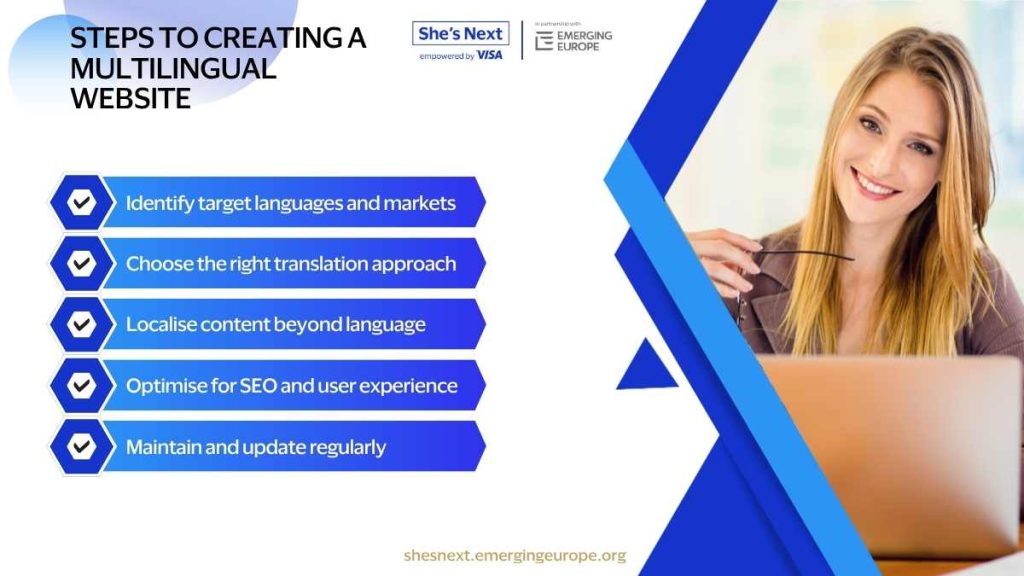
Identify target languages and markets
Start with strategy, not guesswork. Use analytics tools like Google Analytics or Semrush to see where your web traffic comes from and which markets show consistent interest. Focus on one or two key languages first — ideally where you already have inquiries or export potential. Consider cultural context, too: what content formats or tones resonate locally?
Tip: Let the data guide your priorities — your most engaged visitors can reveal your best next market.
Choose the right translation approach
Translation isn’t just linguistic — it’s emotional. Professional human translators ensure tone, nuance, and cultural accuracy. AI-powered tools such as Weglot or Lokalise can accelerate scaling but should be paired with human review for context and quality. Combining automation with editing gives you both efficiency and authenticity.
Tip: Avoid literal translation. Instead, use transcreation — adapting text so it sounds natural and engaging in the local language.
Localise content beyond language
True localisation goes deeper than words. Adapt currencies, measurements, visuals, and contact details to each market’s norms. Choose culturally appropriate images, colours, and examples. Optimise your SEO keywords for local search patterns — what people type in one country might differ slightly elsewhere.
Example: A “holiday sale” may resonate as a “summer special” or “end-of-year offer” elsewhere. Adapt meaning, not just vocabulary.