
How to Test Business Ideas Quickly Before Committing Resources

Building a product that nobody wants is one of the most expensive mistakes a founder can make.

Many entrepreneurs spend months refining an idea in isolation—only to discover, at launch, that there is little or no demand. The issue is not execution. It is testing assumptions too late.
The objective is simple: validate demand before committing resources. This guide outlines a five-step framework to test your ideas in the real market within days, not months.

Build a ‘Painted Door’

You do not need a finished product to test whether people are interested. You only need to test whether they take action.
Create a simple one-page landing page that clearly explains your offer, including pricing and a call to action such as “Buy Now” or “Join the Waitlist.” Tools like Carrd, Wix, or Mailchimp are sufficient.
The key metric is not traffic—it is intent.
If visitors do not click, sign up, or attempt to purchase, the idea needs to be reconsidered before any further investment.

Deliver a ‘Concierge’ MVP

Before automating anything, prove that customers are willing to pay for the outcome.
Offer your service manually to a small number of early users. Deliver the result without building the full product or platform. For example, instead of building a complex platform, provide the service directly—through email, spreadsheets, or simple communication tools.
If customers are not willing to pay for the manual version, they are unlikely to pay for a more sophisticated version.
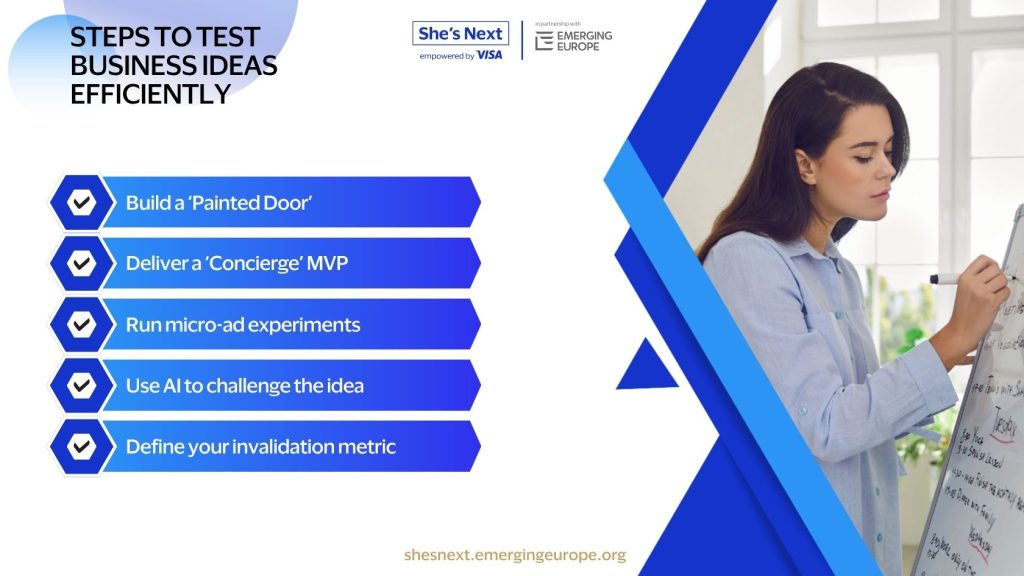

Run micro-ad experiments

Use paid ads as a testing mechanism, not a scaling strategy. Allocate a small budget to test different messages. Create several variations of your offer, each emphasising a different benefit or angle.
The objective is to measure which message resonates most. Metrics such as click-through rate and cost per click indicate what attracts attention and interest.
This approach helps refine positioning before committing to a broader marketing strategy.

Use AI to challenge the idea

Before exposing your idea to the market, pressure-test it.
Use AI to simulate critical feedback: “Act as a sceptical customer. I am launching [your idea] at [your price]. What are the main reasons you would not buy this? What would need to change to make it compelling?”
This helps identify weaknesses in positioning, pricing, or perceived value. Addressing these issues early increases the chances of meaningful market validation.

Define your invalidation metric

Testing only works if you know what failure looks like.
Set a clear, numerical threshold before launching your test. For example: “If 500 people visit the landing page and fewer than 20 sign up, the idea is not strong enough to pursue.”
This prevents emotional bias from influencing decisions. Without a defined baseline, there is a tendency to continue investing in ideas that are not performing.

Testing ideas quickly is not about cutting corners—it is about reducing risk. By validating demand early, you avoid investing time and capital into assumptions.
A practical next step: build a simple landing page for your idea and define your success threshold before driving any traffic.

Related Articles