
How to Make Confident Decisions with Limited Information

Waiting for complete certainty is one of the fastest ways to lose momentum.

In most business situations—especially in fast-moving or emerging markets—you will never have all the data you want. Yet delaying decisions in search of perfect information leads to missed opportunities and stalled progress.
The objective is not to eliminate uncertainty. It is to navigate it effectively. This guide outlines a structured approach to making confident decisions, even when the picture is incomplete.

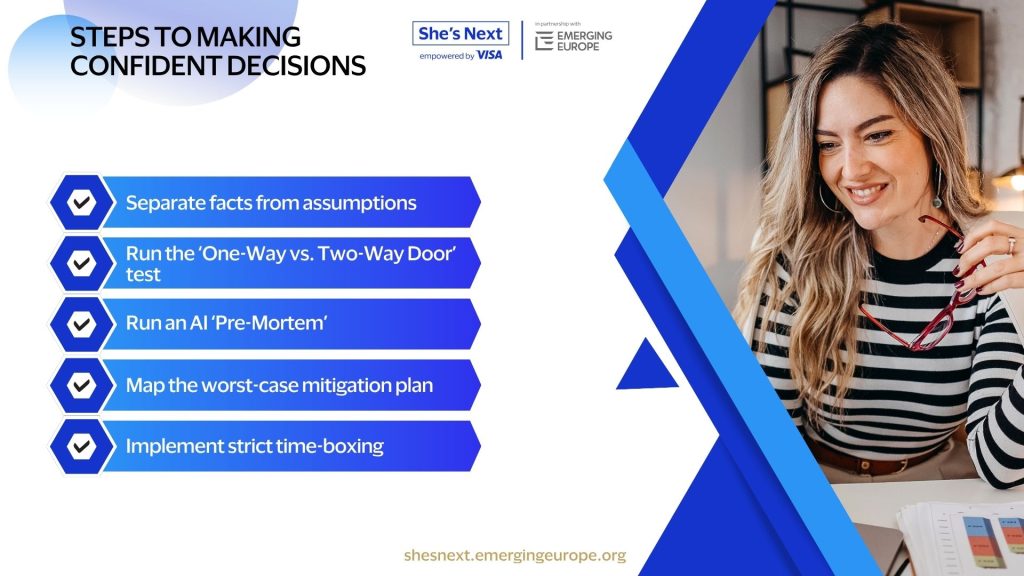
Separate facts from assumptions

Uncertainty often feels overwhelming because facts and assumptions are mixed together.

Create a simple split:
> On one side, list what you know with certainty (financial position, current performance, confirmed data).
> On the other, list what you are assuming (pricing acceptance, customer behaviour, market response).

This distinction shifts your focus. Instead of trying to solve everything at once, you concentrate on validating the assumptions that matter most.

Apply the ‘One-Way vs. Two-Way Door’ test

Not every decision requires the same level of caution.

Use a simple classification:
> Two-Way Door decisions are reversible. You can test, adjust, or undo them with limited consequences.
> One-Way Door decisions are difficult or impossible to reverse. They carry long-term impact.

For reversible decisions, act quickly—even with incomplete information. Waiting adds little value. For irreversible decisions, take more time and gather deeper insight before committing.

Run an AI ‘Pre-Mortem’

Instead of reacting to failure, anticipate it.
Use AI to simulate a negative outcome: “Act as a critical business analyst. I am about to make this decision: [insert decision]. Assume that in six months it failed completely. What are the most likely reasons, and what should I address now to prevent them?”
This exercise highlights risks you may not have considered. It also shifts your mindset from optimism to preparedness—without becoming paralysed.

Map the worst-case mitigation plan

Fear often comes from undefined consequences.
Once potential risks are identified, define how you would respond if things go wrong.
You can structure this with AI: “Based on the risks identified, outline a simple recovery plan. What are the first three steps to stabilise revenue and protect reputation?”
When you know how you would respond, the decision becomes more manageable. You are no longer reacting—you are prepared.

Implement strict time-boxing

Decision-making expands to fill the time available.
Set a clear deadline—whether it is a few hours or a couple of days. Use that time to gather input, test assumptions, and assess risks. When the deadline arrives, decide.
In many cases, taking action is the only way to generate the information you are missing. Waiting rarely provides clarity on its own.

Confidence in decision-making does not come from certainty. It comes from structure, discipline, and the ability to adapt.
A practical next step: take one pending decision and run a structured pre-mortem before your deadline. The insights you gain will make the choice clearer—and the outcome more manageable.

Related Articles