


How to Use AI to Turn Customer Feedback into Strategic Insights

Your customers are already telling you how to improve your business. The question is whether you are able to listen—at scale.
Most founders are not short of feedback. They are overwhelmed by it. Emails, reviews, surveys, and messages accumulate quickly, and manually analysing them is time-consuming and inconsistent.

AI changes this dynamic. It allows you to process large volumes of feedback instantly and extract patterns that would otherwise remain hidden. This guide shows you how to turn raw customer input into structured, actionable insight.

Centralise and anonymise your data

AI works best when it has a clear, consolidated dataset. Fragmented inputs lead to fragmented insights.
Start by gathering recent feedback into one place. This could include customer emails, survey responses, support tickets, or online reviews.
Before using any AI tool, remove all personally identifiable information—names, email addresses, phone numbers. This is essential to remain compliant with data protection regulations such as GDPR. The result should be a clean, anonymised dataset ready for analysis.

Run a rapid sentiment analysis

Before diving into detail, establish a high-level view of how customers feel.
Use a prompt such as: “Act as a customer success manager. I am going to paste customer feedback below. Categorise the overall sentiment as percentages (Positive, Neutral, Negative). Then group the feedback into the three main themes customers are discussing.”

This provides an immediate overview:
> Are customers generally satisfied or frustrated?
> What topics dominate the conversation?

It sets the direction for deeper analysis.
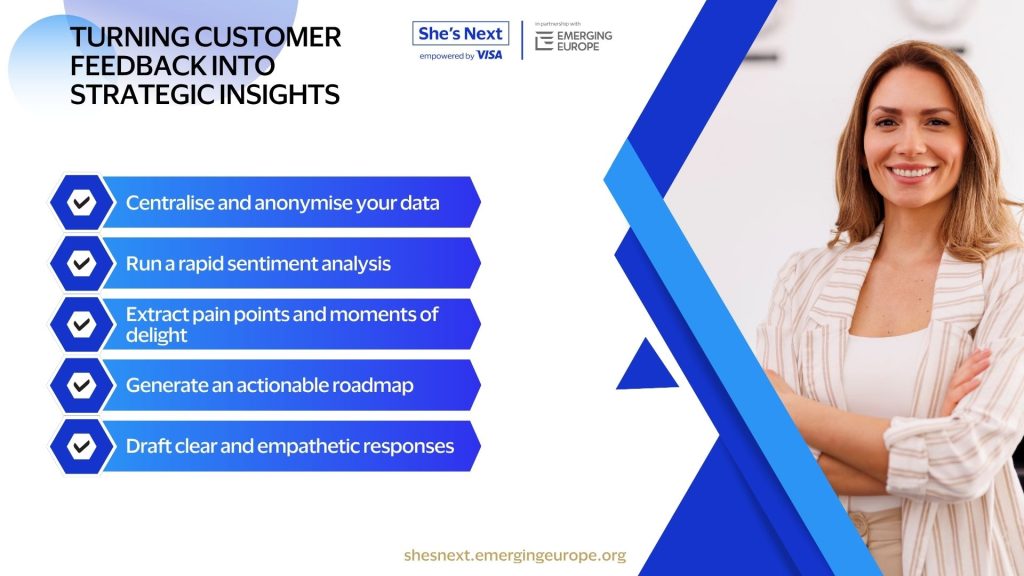
Extract pain points and moments of delight

High-level sentiment is useful, but it is not enough. You need to understand what is driving it.
Use a prompt such as: “Based on this feedback, identify the top three recurring frustrations (Pain Points) and the top three things customers value most (Moments of Delight). Include direct quotes to support each point.”
This step reveals what is broken—and what should be protected.
Pain points often highlight operational issues, unclear communication, or unmet expectations. Moments of delight point to strengths you can double down on in your positioning.

Generate an actionable roadmap

Insights only matter if they lead to decisions.
Use the AI to move from diagnosis to action: “Act as a business strategist. Based on the top three frustrations identified, suggest three low-cost, high-impact changes I can implement within the next month.”
This turns feedback into a practical plan. The focus should be on quick wins—adjustments that improve customer experience without requiring significant investment.

Draft clear and empathetic responses

Customer feedback should not be analysed and ignored. It should be acknowledged and addressed.
AI can help you respond consistently and professionally, especially in emotionally charged situations.
Use a prompt such as: “A customer left this negative review about shipping delays: [insert review]. Draft a polite and empathetic response. Apologise, explain that improvements are being made, and offer a small gesture of goodwill.”
This ensures that communication remains calm, constructive, and aligned with your brand.

Customer feedback is one of the most valuable assets your business has—if you know how to use it.
AI allows you to move from scattered input to structured insight quickly and consistently.
A simple next step: gather your most recent customer feedback, anonymise it, and analyse the key pain points. The patterns you uncover will point directly to your next improvements.

Related Articles